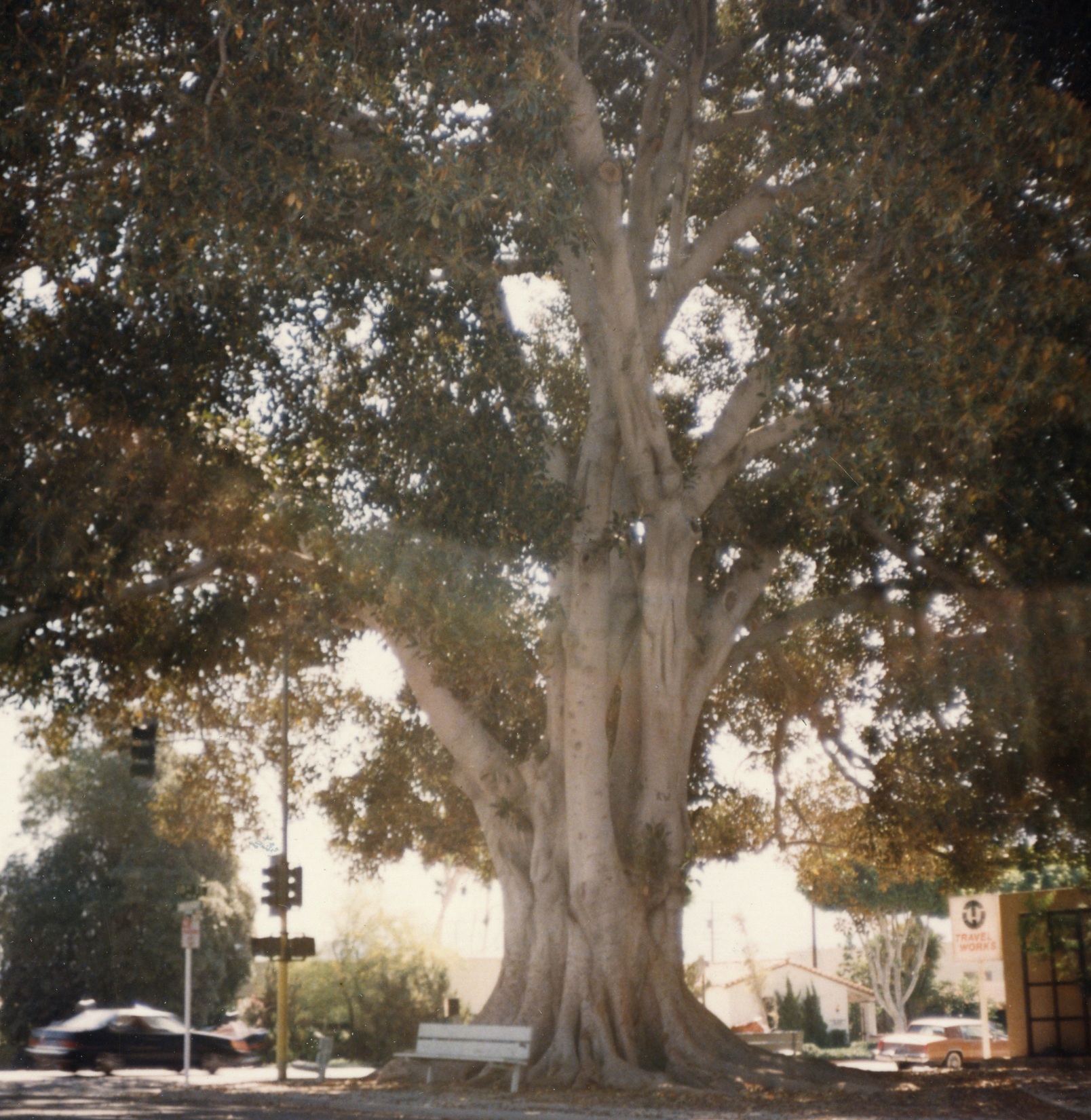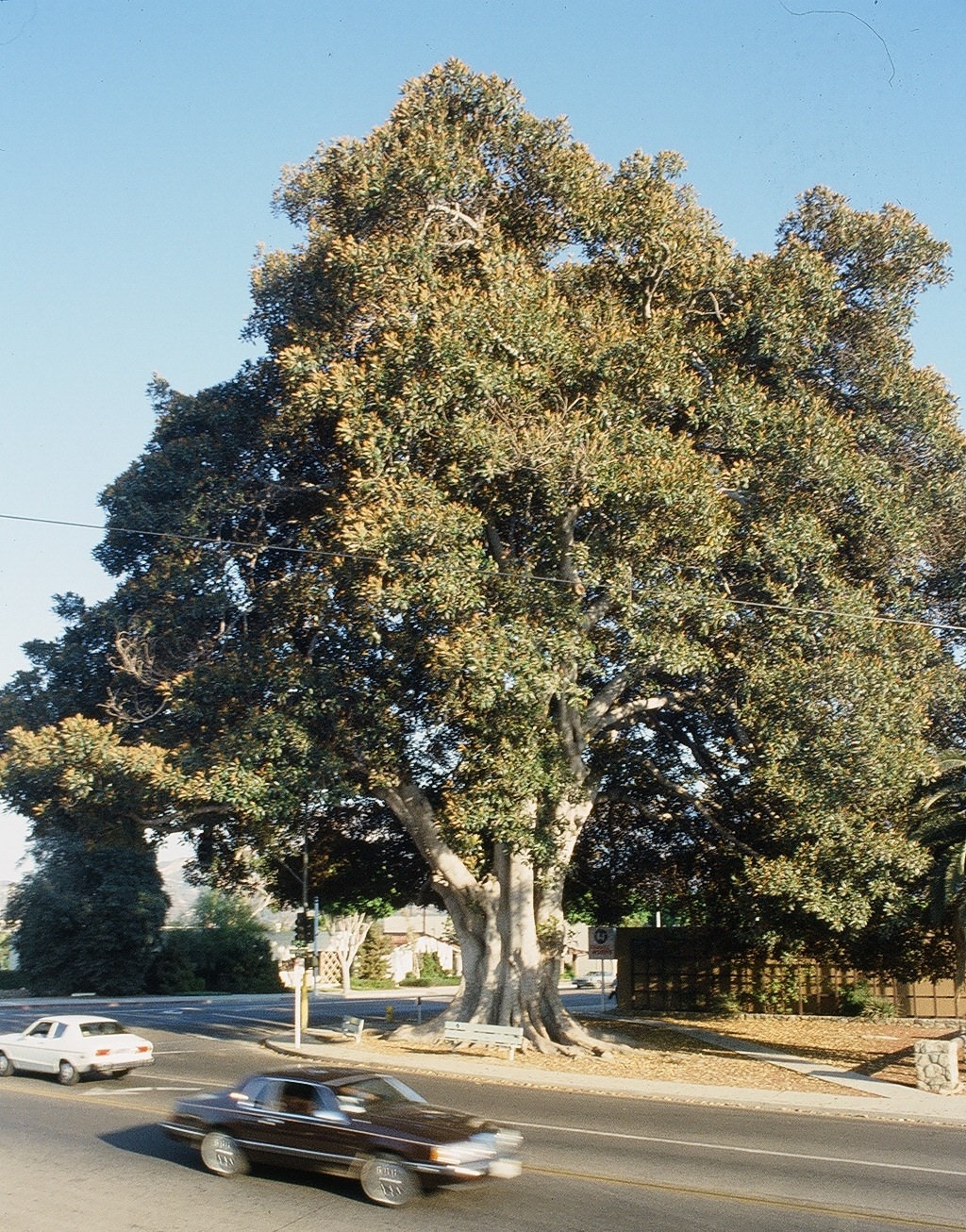
Moreton Bay Fig Tree, 2025. Credit: Google Maps.
Ventura County Landmark No. 79: Moreton Bay Fig Tree, Santa Paula
Historical Background
On July 4, 1879, Reverend Eben H. Orne planted this tree in honor of the birth of his daughter, Cecilia. The sapling was part of a supply of Moreton Bay fig (Ficus macrophylla) trees brought to Ventura County in the mid 1870s, after a nurseryman transported them south from San Francisco in five gallon containers (Santa Paula Chronicle, 1992).
Conservation Effort
The tree had been planted directly across from the Southern Pacific Railroad Depot. With the prospect of potential redevelopment of the Moreton Bay Fig Tree site, a group of concerned citizens organized to save the historic tree in 1961. As described in the Santa Paula Chronicle (August 4, 1992), concerned Santa Paula residents formed a legal trust and named it The Citizens Memorial Park Trust. They were motivated by the possibility that the site, directly across from the Southern Pacific Railroad Depot, might be used for commercial development. It was on September 16, 1961, that a group of more than 20 people met and elected Dr. Gilbert Jackson their chairman, and Edwin Beach, Charles Lockwood, and Gus Quick trustees of the Memorial Park Trust Association.
The goal was to collect $7,000, which would purchase half of the lot on the southwest corner of 10th and Santa Barbara Streets. The Methodist Church had offered $5,000 for the other half of the lot, as they needed additional parking space. Contributions poured in from more than 400 people and organizations—some small, some large—as this became a genuine community cause. Hard work, organization, dedication, and generosity produced a successful campaign, collecting $7,246.04 by February 19, 1962. One half of “Lot #1, Block #56” was purchased on March 5, 1962, and the citizens gave this small plot of land, along with the fig tree, to the City of Santa Paula.
The Tree Today
This once small sapling, delivered from San Francisco in a five gallon container, continues to thrive and stands as a living tribute to Reverend Orne and to the citizens of Santa Paula who worked so diligently to protect it.
The tree remains in good health with an indefinite lifespan—thanks to the many people who invested their time, energy, expertise, treasure, and enthusiasm to save it (Santa Paula Chronicle, 1992).
Additional Reading
Reference
Santa Paula Chronicle. (1992, August 4). Moreton Bay Fig tree. https://santapaulatimes.com/news/archivestory.php/aid/2521/Moreton_Bay_Fig_tree.html.
Date Designated: September 1982
Location: Corner of Tenth and Santa Barbara Streets, Santa Paula
Photos: